

The Hyperion FT-IR Microscope (HYPERION II) is a high-end research instrument developed for advanced material characterisation and scientific discovery. It combines precision FT-IR microscopy with optional Infrared Laser Imaging (QCL) in a single, modular platform. Built for flexibility and performance, the system supports a wide range of configurations, making it ideal for demanding R&D and analytical applications.
FT-IR Microscopes
Hyperion FT-IR Microscope
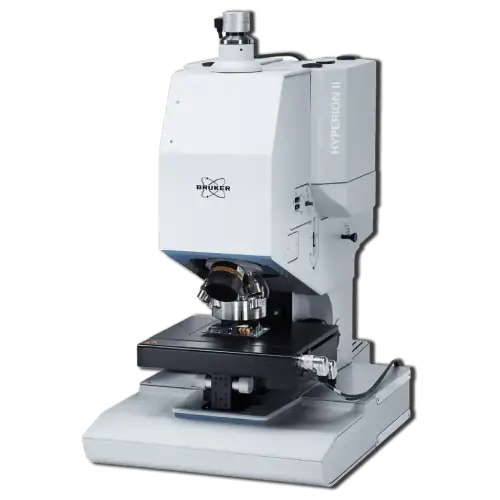
What you need to know about Hyperion FT-IR Microscope?
Advancing Infrared Microscopy Standards
The Bruker Hyperion II FT-IR Microscope represents a major step forward in infrared imaging technology. It enables detailed IR imaging at the diffraction limit and delivers outstanding performance in ATR microscopy. As the first microscope to integrate FT-IR spectroscopy and Infrared Laser Imaging (ILIM), it supports transmission, reflection, and ATR measurements within one powerful system.
Key Advantages
Intelligent Chemical Detection
Automatically identifies chemical components without predefined classes
Efficient, Automated Workflows
Reduces manual interpretation and speeds up analysis
Ideal for Complex or Unknown Samples
Well-suited for distribution studies and micro-scale chemical imaging
Simplified Data Evaluation
Minimises effort while improving productivity and accuracy
Designed for Advanced Research Applications
The Hyperion FT-IR Microscope (HYPERION II) is built for researchers who require maximum control and adaptability. Its modular design, precision optics, and extensive configuration options make it more than just a microscope—it becomes a natural extension of expert analytical workflows.
Complete Control Over Infrared Experiments
What distinguishes the Hyperion II is the level of control it offers. Researchers can adjust experimental parameters in real time and tailor each measurement to their specific requirements.
Users have full access to:
- Sample positioning and measurement parameters
- Single-point analysis, mapping, and full-field imaging
- Multiple detector, objective, and stage configurations
- Advanced techniques such as ATR and Grazing Angle microscopy
Built for Expert Users
Unlike automated systems designed for routine testing, the HYPERION II is intended for skilled users who want hands-on control over every aspect of data acquisition. It follows the operator’s instructions precisely, offering unmatched accuracy and repeatability for advanced research tasks.
A Trusted Platform, Re-Engineered
The Hyperion II continues the legacy of the widely trusted HYPERION I, a platform relied upon by researchers for nearly two decades. All proven features—such as MCT detectors, FPA imaging, and visual/IR enhancement tools—remain, now enhanced with improved speed, intelligence, and performance.
This evolution blends established FT-IR methods with modern imaging technologies to meet today’s research challenges.
Combining FT-IR and QCL Imaging in One System
For the first time, FT-IR spectroscopy and Quantum Cascade Laser (QCL) imaging are available within a single microscope. Researchers can collect a full FT-IR spectrum, select target wavelengths, and generate high-contrast chemical images using QCL—all in one workflow.
True QCL Microscopy Without Artifacts
The Hyperion II is engineered as a dedicated QCL microscope, not an add-on solution. Its patented coherence-reduction technology eliminates common laser-related artifacts such as fringes and speckle patterns. This ensures clean, reliable chemical images without post-processing corrections.
As a result, users achieve fast, artifact-free IR laser imaging even in challenging microscopic environments.
No Compromises Between FT-IR and QCL
- FT-IR provides broad spectral coverage and analytical versatility
- QCL imaging delivers rapid, high signal-to-noise imaging within selected IR bands
With the Hyperion II, researchers can choose the best technique for each task—without limitations.
OPUS 8.7 Software Enhancements
The OPUS 8.7 software update further expands the analytical capabilities of the Hyperion II with smarter, more autonomous data processing.
Adaptive K-Means Clustering
- Advanced unsupervised classification for complex chemical datasets
Cluster ID for 3D Spectral Data
- Simplifies chemical identification using integrated spectral comparison tools
Applications include:
- Particle and fibre analysis
- Layer characterisation in laminates
- Pharmaceutical and heterogeneous material analysis
Improved Particle Detection
- Enhanced accuracy for low-contrast samples
- Enables post-run particle size measurement using chemical imaging data
It's the Swiss-Knife of FT-IR Microscopes
Hyperion FT-IR Microscope Features:
Detector Flexibility for μ-FT-IR
- Liquid nitrogen-cooled MCT detectors (broad-, mid-, and narrow-band)
- Thermoelectrically cooled MCT detector for routine and flexible use.
Infrared Imaging Capability
- Focal Plane Array (FPA) detectors with 64 × 64 or 128 × 128 pixels
- Enables fast data acquisition with high spatial resolution
Optional QCL Imaging
- Laser Infrared Imaging Module (ILIM, Class 1)
- Allows seamless integration of QCL imaging with FT-IR analysis
Wide Selection of Objectives
- IR objectives: 3.5×, 15×, 36×
- ATR: 20×
- Grazing Incidence Reflection (GIR): 15×
- Visible optics: 4× and 40×
- Designed to suit multiple sample types and magnification needs
Extended Spectral Coverage
- Supports Near-IR to Far-IR measurements for diverse applications
Precision Aperture Control
- Manual or automated knife-edge aperture wheel
- Metal apertures for accurate NIR measurements
Sample Stages & Accessories
- Macro IR imaging accessory
- Heating and cooling stages
- Expandable sample compartments for specialised experiments
Advanced Optical Enhancements
- Darkfield and fluorescence illumination
- Visual and IR polarisation options for improved contrast and interpretation
Applications of Hyperion FT-IR Microscope
Pharmaceuticals
Tablet mapping, contamination analysis, and verification
Emissivity Studies
LED analysis and thermal property evaluation
Failure Analysis
Root cause identification and defect investigation
Forensics
Trace material and evidence analysis
Microplastics
Detection in environmental samples
Industrial R&D
Materials development and surface engineering
Polymers & Plastics
Composition, phase separation, additive distribution
Surface Analysis
Coatings, films, and treatments at the micro-scale
Semiconductors
Contaminant detection and quality control
TECHNICAL SUPPORT FOR Hyperion FT-IR MICROSCOPE
We provide comprehensive technical support, application assistance, and maintenance services for the MPA III FT-NIR Spectrometer, ensuring stable operation, accurate analytical results, and long-term instrument reliability. Our support covers system installation, method development, calibration, troubleshooting, and software assistance across pharmaceutical, food, chemical, polymer, and agricultural applications. As an Authorized Distributor of Bruker Optics GmbH & Co. KG in India, we deliver specialized service and application support aligned with regulatory, quality, and operational requirements of modern analytical laboratories.
-
Instrument setup & configuration
-
System installation, module and probe selection, optical alignment, detector and source optimization, and performance verification.
-
-
Method development
-
Selection of measurement mode, spectral range, resolution, scan parameters, sampling techniques, and development of robust NIR methods.
-
-
Calibration & validation
-
Wavelength and photometric calibration, performance qualification (IQ/OQ/PQ), reference material verification, and chemometric model validation.
-
-
Data acquisition issues
-
Low signal intensity, noisy spectra, baseline instability, sampling inconsistencies, probe contamination, and repeatability concerns.
-
-
Data interpretation
-
Spectral evaluation, identification of chemical and physical variations, multivariate analysis (PCA, PLS), and correlation with reference methods.
-
-
Troubleshooting errors
-
Optical path issues, fiber or probe damage, detector or source faults, environmental effects, model prediction errors, and software warnings.
-
-
Maintenance & best practices
-
Routine system checks, cleaning of accessories, lamp monitoring, reference scans, preventive maintenance, and contamination control.
-
-
Software help
-
OPUS software support, chemometric model development, calibration transfer, library management, validation workflows, and reporting.
-
Why Choose Nexus Analyticals?
Research & Development
Are you interested in our products or services?
Get in touch with us today for a personalized quote.