

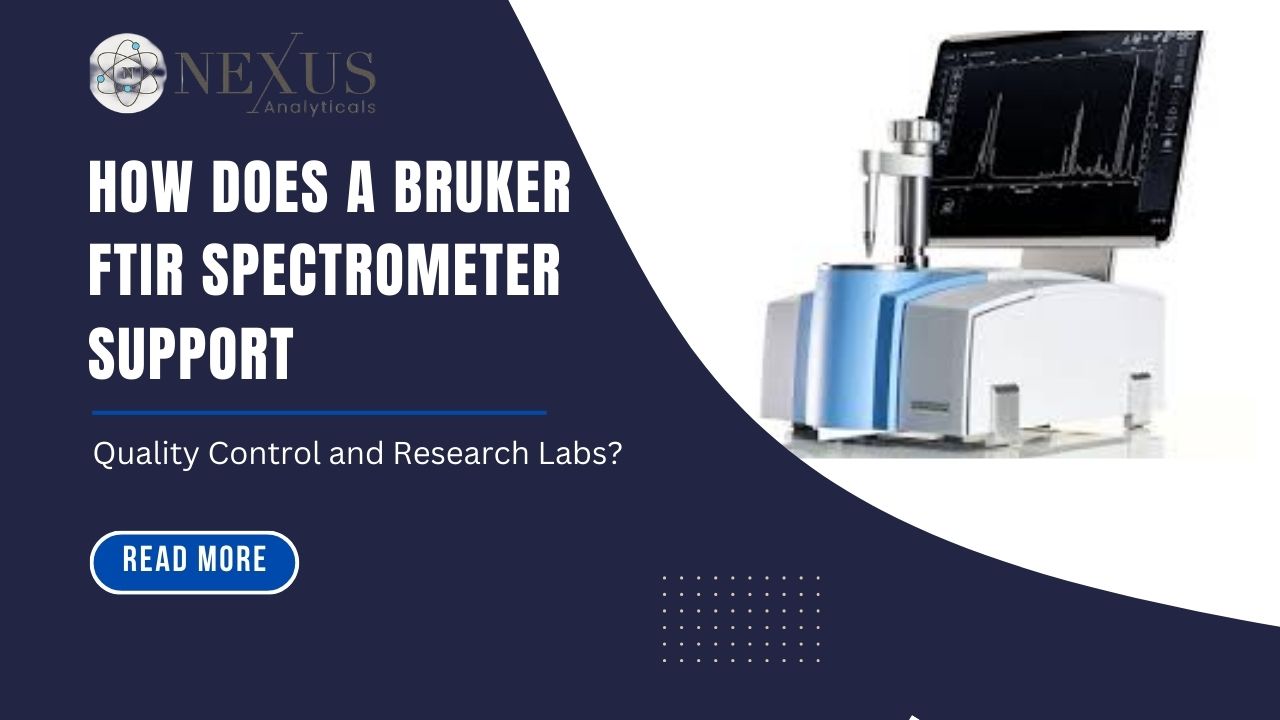
Quality control and research labs depend on tools that deliver accurate, repeatable, and fast results. When materials must meet strict standards, even small errors can cause major setbacks. This is where a Bruker FTIR spectrometer becomes a reliable partner, especially for teams seeking clear answers to questions like How Does Bruker FTIR Spectrometer Work in real-world lab settings.
From routine inspections to advanced research work, this instrument supports labs by providing clear molecular insights. It helps teams understand what a material contains, how it behaves, and whether it meets required specifications.
Let’s explore how it works and why labs trust it every day.
Did you know?
FTIR spectroscopy creates a molecular “chemical fingerprint” to accurately identify and verify materials, making it ideal for quality control across industries? Source
Why Do Quality Control and Research Labs Need FTIR Technology?
Modern materials are complex. Many substances appear identical but differ at a molecular level. FTIR technology allows labs to identify those differences clearly.
Labs use FTIR instruments to:
- Verify incoming raw materials
- Detect contamination early
- Maintain batch consistency
- Support regulatory compliance
- Improve research efficiency
This level of insight reduces risk and improves overall lab reliability.
How Does a Bruker FTIR Spectrometer Work in Real Lab Environments?
Understanding How Does Bruker FTIR Spectrometer works helps explain its everyday value. The system measures how infrared light interacts with a sample. Every material uniquely absorbs infrared energy, creating a molecular fingerprint.
In real lab settings:
- Samples need little preparation
- Infrared light passes through or reflects from the sample.
- Absorption patterns are recorded.
- Software compares results with known references.
This allows labs to make quick, confident decisions without damaging samples.
What Is the Bruker FTIR Working Principle in Simple Terms?
The Bruker FTIR working principle is based on molecular vibration. When infrared light hits a substance, chemical bonds vibrate at specific frequencies.
This principle works because:
- Each bond absorbs specific wavelengths
- The resulting spectrum is unique.
- Results are repeatable and consistent.
- Even complex mixtures can be analyzed.
This approach delivers accurate data across many applications.
How Do Compact FTIR Systems Support Faster Lab Testing?
Many labs need reliable results without large, complex equipment. Compact systems like the Bruker Alpha II FTIR offer strong performance in a smaller footprint.
These systems help labs by:
- Saving bench space
- Delivering fast measurements
- Supporting routine quality checks
- Allowing easy operation by lab staff
This makes them ideal for busy quality control and research environments.
How Does Bruker FTIR Improve Daily Quality Control Processes?
Quality control labs focus on consistency and accuracy. Bruker FTIR instruments help maintain product standards throughout production cycles.
Daily QC benefits include:
- Immediate raw material verification
- Early detection of formulation errors
- Batch comparison for uniform results
- Reduced product waste and rework
This helps labs catch problems before they become costly issues.
Why Is Bruker FTIR Important for Research and Development Labs?
Research labs often work with unknown or experimental materials. FTIR analysis supports exploration while keeping data reliable.
R&D teams use FTIR to:
- Study new chemical formulations
- Monitor reaction changes
- Compare experimental outcomes
- Build reliable research documentation.
This balance of speed and accuracy supports innovation.
How Does the Bruker FTIR Spectroscopy Principle Ensure Accuracy?
The Bruker FTIR spectroscopy principle measures how materials absorb infrared light across a broad wavelength range. This creates detailed molecular information.
This principle supports accuracy by:
- Providing high chemical specificity
- Reducing misidentification risks
- Supporting qualitative and quantitative analysis
- Working across solids, liquids, and gases
This reliability is essential for regulated industries and academic research.
Which Industries Commonly Use Bruker FTIR Spectrometers?
FTIR technology supports many industries where material quality matters.
Common industries include:
- Pharmaceuticals
- Chemicals
- Polymers and plastics
- Food and beverage
- Environmental testing
Working with a trusted analytical instruments supplier ensures labs receive the right system, training, and long-term support.
How Does Bruker FTIR Support Compliance and Documentation?
Regulatory standards require traceable and repeatable results. Bruker FTIR systems help labs meet these expectations with ease.
Compliance benefits include:
- Automated data storage
- Standardized testing methods
- Clear report generation
- Audit-ready documentation
This simplifies inspections and improves confidence in lab records.
Related Blog:-
Which Features Make the Bruker ALPHA FTIR Spectrometer Ideal for Material Analysis?
What Makes Bruker FTIR Easy for Lab Teams to Use?
Advanced analysis should not slow down productivity. Bruker FTIR systems are designed with user experience in mind.
Ease-of-use features include:
- Intuitive software
- Clear spectral visuals
- Minimal training needs
- Fast setup and operation
This allows teams to focus on results, not troubleshooting.
Key Takeaway:
- Bruker FTIR spectrometers provide fast and accurate molecular identification.
- They support both quality control and research lab workflows.
- FTIR analysis helps detect contamination and material inconsistencies early.
- Compact systems fit easily into modern laboratory environments.
- Reliable data improves compliance, documentation, and decision-making.
Frequently Asked Questions
Q1. Can Bruker FTIR analyze different sample types?
Yes, it works with solids, liquids, and gases.
Q2. Is FTIR testing destructive?
No, most FTIR tests are non-destructive.
Q3. How long does FTIR analysis take?
Results are usually available within minutes.
Q4. Is FTIR suitable for regulated industries?
Yes, it supports compliance and documentation needs.
Q5. Can FTIR systems be used for routine testing?
Yes, they are ideal for both routine and advanced analysis.