

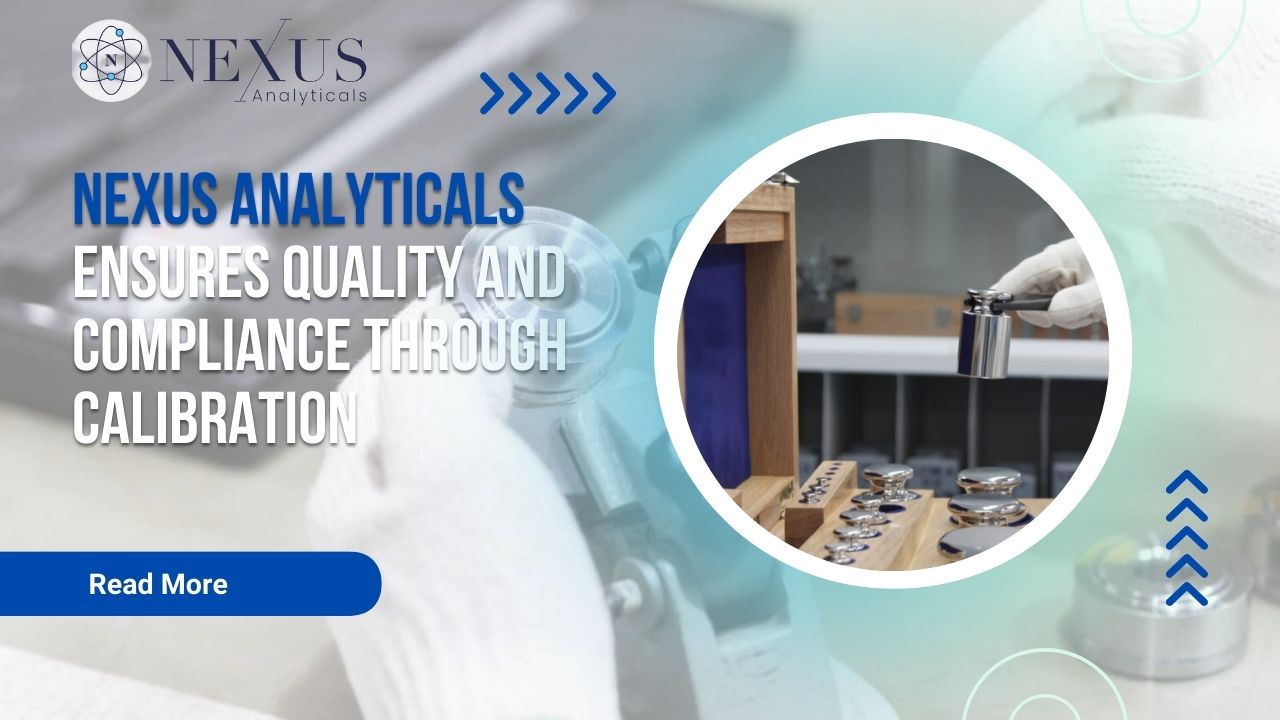
In today’s businesses that depend on precision, it’s important to know how calibration ensures measurement accuracy in order to stay ahead of the competition and follow the rules. Every measurement your lab makes has an impact on important choices, such as the safety of patients and the quality of the products. Calibration standards are the most important part of valid scientific data, and we at Nexus Analyticals know this.
Nexus Analyticals has been in the business of analytical services for decades and is now a trusted partner for labs that want accuracy, compliance, and high quality in their measurement procedures.
Did you know?
Proper calibration not only ensures compliance but can reduce product rework and waste, saving labs significant time and cost by preventing inaccurate measurements at an early stage.
Understanding the Basics of Accurate Measurement
Calibration isn’t just something you have to do to follow the rules; it’s the scientific way to make sure your instruments are giving you the right information.
How calibration ensures measurement accuracy involves comparing your instrument’s readings against known reference standards and making necessary adjustments. This procedure makes sure that a gram measured in your building is the same as a gram measured somewhere else in the world.
Important Parts of Effective Calibration
- Traceability: There must be a chain of comparisons that goes back to national or international standards for all measures.
- Writing it down: Complete records show that all measurements were taken correctly and hold people accountable for them.
- Frequency: Regular calibration stops drift and keeps accuracy steady, ensuring devices such as a conductivity electrode perform consistently.
- Environmental Control: Monitoring temperature, humidity, and other parameters is crucial for accurate calibration results.
The Important Role of Calibration in Quality Control Systems
You can’t stress enough on the importance of calibration in quality control. ISO 9001, ISO/IEC 17025, and FDA rules are examples of quality management systems that need periodical calibration as a basic requirement. It is the only thing that keeps your whole quality system from falling apart.
How Calibration Makes Quality Control Better:
- Stops Measuring Drift: Instruments naturally lose accuracy over time because of wear and tear, the environment, and frequent usage.
- Checks Process Control: Keeps industrial processes from going too far outside of what is acceptable.
- Reduces Waste: By making sure that the proper quantity of resources are used, fewer batches are wasted.
Why Professional Calibration Services Need Experts
Benefits of professional calibration services are more than just correcting instruments; they can also do other things that are good for you. Professional suppliers know more about their products and have superior instruments.
Why it’s a good idea to have professional calibration:
- Technicians that have worked in the field: Professionals who have been trained know how to use a wide range of tools, laboratory equipment, and advanced technology.
- Standards of Reference: Access to higher-accuracy standards that can be traced back to national metrology institutes
- Full functional verification: Beyond simple calibration checks, this is part of comprehensive testing.
- Confidence in the rules: During audits and inspections, third-party credentials are more important.
To understand how calibration ensures that measurements are accurate, you need to know that the calibration procedure itself must be done with great care.
Making a Strong Calibration Program
A systematic strategy is needed in accordance with the importance of calibration in quality control. Successful labs have full calibration management processes that make sure that no instrument is missed.
A few important parts of the program are:
- It is called an “instrument inventory” to keep track of all the tools that need to be adjusted.
- Making a plan that takes risk into account: How often you adjust something is based on how important it is and how you use it.
- Regular maintenance and testing are both parts of preventive maintenance. The goal is to make things last as long as possible.
The role of calibration in maintaining industry standards is very essential, and it needs to be done with dedication and ongoing improvement. Every once in a while, labs should check and update their calibration tools to make sure they are still in line with the latest rules and technology.
Your Partner in Truth: Taking Steps Forward with Faith
Quality and compliance are not fixed for ideas; they are ongoing processes that require a strong commitment to accurate measuring to achieve desired results. The benefits of professional calibration services extend beyond simply meeting standards. They make every part of your lab work more precisely, whether you’re analyzing samples, testing instruments, or working with sensitive tools like a spectroscopic cuvette.
We at Nexus Analyticals understand how crucial it is for your reputation that all of your measurements are correct. With our full variety of calibration services, you can be sure that you’ll get accurate results, follow the rules, and keep the highest standards of scientific integrity.
Read More Blogs :-
Frequently Asked Questions
Q1: How often should the tools in a lab be calibrated?
The amount of time between calibrations relies on the manufacturer’s suggestions, how often the device is used, and government rules. Usually, it’s done once a month to once a year.
Q2: What does it mean if a device doesn’t calibrate correctly?
Instruments that have broken down need to be taken out of service, marked, and either fixed and recalibrated or replaced before they can be used again.
Q3: Can labs do their own calibrations?
Yes, but labs need to have qualified staff, reference standards that can be tracked, and written processes that follow the rules.
Q4: What does NIST tracking mean, and why is it important?
Through recorded comparison chains, NIST traceability links measurements to national standards. This makes sure that measurements are used consistently around the world and are accepted by regulators.
Q5: How long should records of testing be kept?
Most rules say that data must be kept for at least as long as the instrument is operating plus one calibration cycle.