

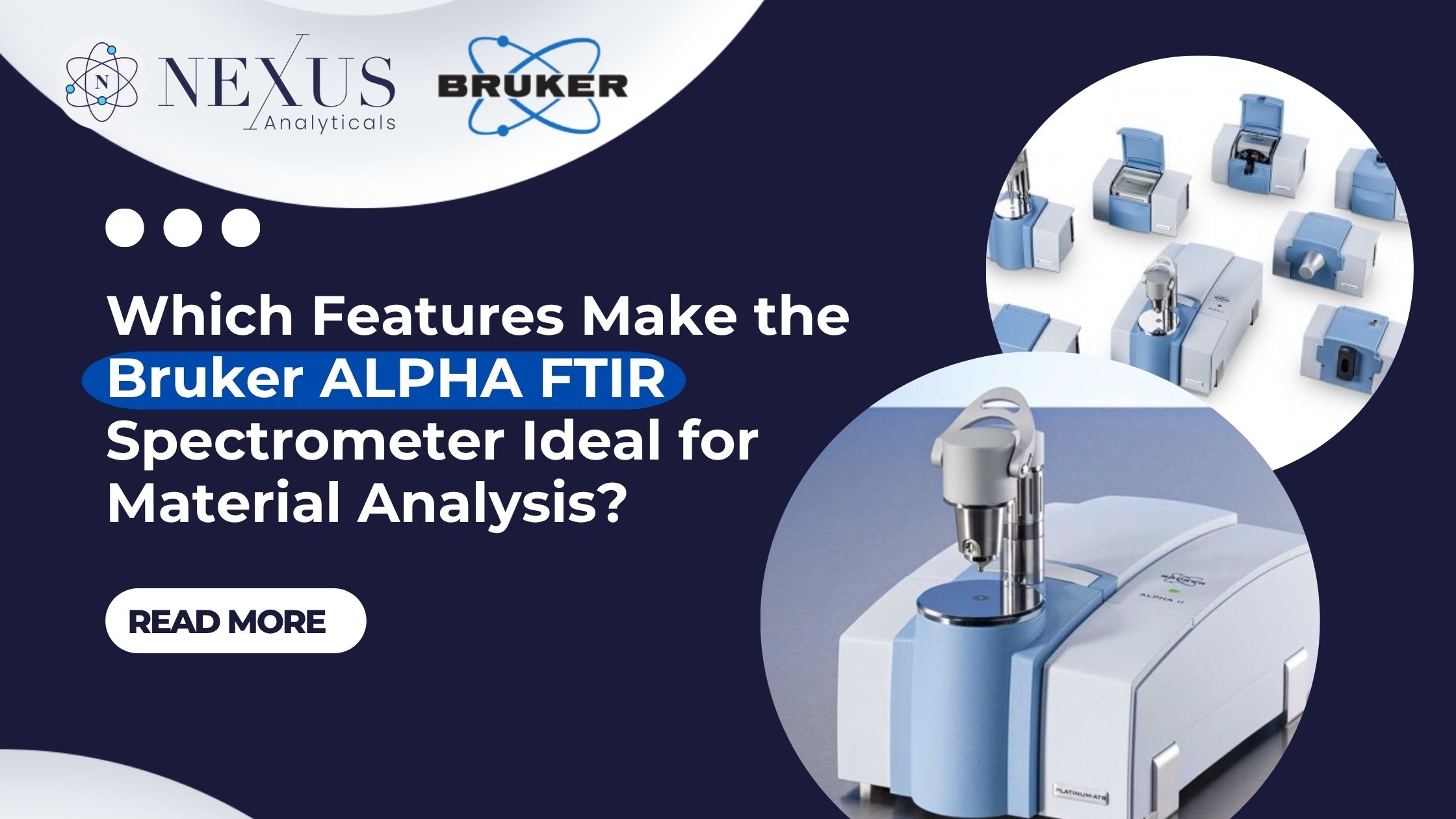
In material science, precision, speed, and reliability are crucial. Researchers and industries analyzing polymers, coatings, or raw materials often struggle to obtain accurate chemical data quickly without bulky instruments. The Bruker ALPHA FTIR Spectrometer addresses this challenge with its compact, high-performance design. Supported by the Bruker Alpha II FTIR spectrometer specifications, it ensures exceptional accuracy, efficiency, and ease of use—making it a trusted choice for consistent material analysis across diverse industries.
At Nexus Analyticals, this technology is transforming how pharmaceutical researchers verify raw materials, ensure product qualWhite Gray Monochrome Business Company Blog Bannerity, and speed up development. Raman spectroscopy offers a smarter, faster, and more reliable way to understand what truly matters — the molecular composition of every ingredient and formulation.
Did You Know?
Handheld instruments like Bruker’s BRAVO Raman spectrometer let pharmaceutical teams verify raw materials on-site — no lab required!
Compact, Smart, and Powerful: Understanding the Bruker Alpha II FTIR Spectrometer Specifications
When it comes to performance in a small package, few instruments match the Bruker Alpha II FTIR Spectrometer specifications. Designed with modern laboratories in mind, the ALPHA II is a compact FTIR spectrometer that fits easily on a bench — about the size of a standard laptop — yet provides analytical capabilities comparable to larger systems.
Its spectral range of 350 – 8000 cm and resolution up to 2 cm or 0.75 allow researchers to identify and quantify a wide variety of materials, from polymers and pharmaceuticals to chemicals and coatings. The RockSolid interferometer ensures alignment stability, while the CenterGlow IR source and temperature-controlled DLaTGS detector maintain consistent signal output even under changing environmental conditions.
The result? Unmatched reliability and repeatability for every measurement — a critical factor for quality control, R&D, and manufacturing applications.
What Makes the Bruker ALPHA FTIR Spectrometer Features So Unique?
The strength of the ALPHA II lies in its user-friendly yet advanced features that simplify complex analytical workflows. Many users face frustration with instruments that require constant recalibration or complex software. The Bruker ALPHA FTIR Spectrometer features eliminate those concerns with a design focused on simplicity and efficiency.
Key highlights include:
- QuickSnap sampling modules – Users can switch between solid, liquid, and gas analysis in seconds without tools.
- Touchscreen interface with OPUS-TOUCH software – Enables fast, intuitive operation with minimal training.
- Pre-calibrated and factory-aligned optics – Reduce the need for frequent maintenance.
- Automatic accessory recognition – The spectrometer automatically detects the attached sampling module and optimizes measurement settings.
Together, these features make the ALPHA II a plug-and-play solution that enhances workflow productivity while maintaining top-level analytical performance.
Why Do the Technical Specifications of Bruker ALPHA FTIR Matter So Much?
Users often ask why the technical specifications of Bruker ALPHA FTIR are essential when comparing spectrometers. The reason is simple: technical details define how accurately and consistently your instrument performs across multiple applications.
For material identification, trace detection, or compositional verification, the ALPHA II delivers precision through its high signal-to-noise ratio (>55,000:1) and stable laser alignment system. Its broad spectral coverage enables users to capture complete molecular “fingerprints,” essential for verifying complex formulations or detecting impurities.
In addition, its fast scanning capability ensures real-time analysis — a major advantage for industries like pharmaceuticals or petrochemicals that require rapid testing to maintain production efficiency.
In short, these specifications aren’t just numbers — they’re performance benchmarks that translate to consistent, reproducible results in your material analysis workflow.
A Closer Look at Bruker ALPHA FTIR Performance Details
When it comes to reliability, the Bruker ALPHA FTIR performance details show why this device stands out in real-world scenarios. Its permanent optical alignment ensures the same accuracy from the first measurement to the thousandth. The sealed, desiccated optics protect against humidity and dust, which means it performs even in demanding environments.
For example, in a manufacturing plant, the ALPHA II can verify raw material batches directly on the production floor. With minimal setup, it delivers immediate feedback on product composition — helping teams avoid costly delays or reprocessing.
Whether used in laboratories or production sites, the ALPHA II’s performance consistency and analytical depth make it a trusted choice among professionals seeking dependable FTIR results.
Precision in Design: Bruker ALPHA FTIR Instrument Design and Accuracy
The Bruker ALPHA FTIR instrument design and accuracy are driven by one goal — simplifying high-precision spectroscopy for users at all expertise levels. Its metal housing, sealed optics, and vibration-resistant interferometer ensure long-term operational stability. The modular architecture allows users to adapt the spectrometer to various sampling needs — solids, liquids, or gases — without complex adjustments.
The instrument’s accuracy, reinforced by its RockSolid interferometer, delivers consistent spectral precision across years of use. This reliability is vital in industries like pharmaceuticals and polymers, where product verification depends on repeatable, standardized data.
By combining robust engineering with precision technology, the ALPHA II proves that compact doesn’t mean compromise — it means smarter design for reliable outcomes.
Why the Compact FTIR Spectrometer by Bruker Redefines Flexibility?
For many labs, space and mobility are constant challenges. That’s where the compact FTIR spectrometer by Bruker redefines how material analysis can be conducted. Despite its small footprint, the ALPHA II integrates seamlessly into diverse environments — from R&D departments to factory QA labs.
Its lightweight structure enables easy relocation without losing calibration or performance stability. This mobility also allows users to perform on-site verification of raw materials or contamination checks in minutes.
By balancing performance and portability, the ALPHA II opens doors to a new era of flexible, accurate, and space-efficient spectroscopy.
What Real Users Appreciate About Alpha II FTIR?
Professionals working in quality control, academic research, and industrial R&D all highlight one aspect of the Alpha II FTIR — reliability without complexity. It offers the same analytical depth as high-end bench models but with the convenience of quick measurements and minimal maintenance.
For instance, laboratories performing FTIR and Raman Spectroscopy can easily integrate the ALPHA II into existing setups for a more comprehensive molecular analysis. It complements Raman instruments perfectly, offering IR insight where Raman may have limitations.
By combining speed, stability, and flexibility, it delivers what modern labs need — trustworthy results with less downtime and lower operational costs.
The Role of FTIR in Advancing Analytical Science
Infrared spectroscopy has been around for decades, yet its relevance continues to grow. The ALPHA II represents the evolution of FTIR — a move toward smaller, smarter, and more reliable systems. In industries using handheld Raman spectroscopy or mobile spectrometers, the ALPHA II fills the gap for high-resolution bench analysis.
It brings lab-grade precision to a compact design, helping users transition seamlessly between field and laboratory analysis. This adaptability is one reason why it’s becoming a mainstay in both education and industry.
How the Bruker ALPHA FTIR Spectrometer Enhances Quality and Compliance?
In regulated sectors like pharmaceuticals, chemicals, and food, quality compliance isn’t optional. The ALPHA II makes this process smoother with built-in validation tools that meet international standards such as PhEur 2.2.24 and USP <854>.
Its automated Operational Qualification (OQ) and Performance Qualification (PQ) routines simplify documentation and ensure every measurement complies with global regulatory frameworks.
With this automation, labs can save time on paperwork and focus more on actual analysis — another reason the ALPHA II remains a preferred choice for quality-driven industries.
Addressing Common Pain Points in Material Analysis
Many professionals often ask:
- How can I ensure data consistency between different operators?
- Is there a spectrometer that doesn’t need constant recalibration?
- Can I verify raw materials on-site without transporting samples to a lab?
The ALPHA II answers all these questions. Its stable design prevents misalignment, the intuitive software minimizes user error, and its portability enables on-site analysis. These real-world benefits turn the ALPHA II into more than an instrument — it’s a complete workflow solution.
The Smarter Way Forward in Material Analysis
Choosing the right spectrometer can transform the efficiency and accuracy of your analytical process. The Bruker ALPHA FTIR Spectrometer combines innovation, reliability, and compact design to help professionals overcome the challenges of modern material analysis.
Its advanced optics, intuitive operation, and high stability make it a long-term investment for any laboratory or production environment. Whether you’re ensuring product quality or researching new materials, the ALPHA II gives you the confidence to achieve consistent, trusted results — every time.
To learn more about how this technology can enhance your analytical capabilities, visit Nexus Analyticals today and explore the future of material analysis.
Key Takeaways:
- The Alpha II FTIR specifications prove that a small design can deliver big performance.
- The Bruker ALPHA FTIR spectrometer features simplify workflows through automation and modular sampling.
- The technical specifications of Bruker ALPHA FTIR ensure reliable, reproducible data for material verification.
- With excellent Bruker ALPHA FTIR performance details, it provides accurate results under any environment.
- The Bruker ALPHA FTIR instrument design and accuracy guarantee stability, durability, and a superior user experience.
- As a compact FTIR spectrometer by Bruker, it’s the perfect balance of mobility and analytical precision.
Frequently Asked Questions
Q1. What materials can be analyzed using the Bruker ALPHA FTIR Spectrometer?
It can analyze solids, liquids, and gases — making it ideal for polymers, coatings, pharmaceuticals, and raw materials.
Q2. How often does the Bruker ALPHA II FTIR require calibration?
Thanks to its permanently aligned optics, it requires minimal recalibration, reducing downtime and maintenance costs.
Q3. Is the ALPHA II suitable for industrial use outside laboratory environments?
Yes. Its compact and robust design allows accurate performance even in factory or on-site conditions.
Q4. Can the ALPHA II work alongside Raman spectroscopy systems?
Absolutely. It complements Raman spectroscopy perfectly, offering infrared data that enhances molecular insights.
Q5. What makes the ALPHA II different from traditional FTIR systems?
Its size, ease of use, stability, and integrated features make it one of the most efficient and user-friendly FTIR systems available.