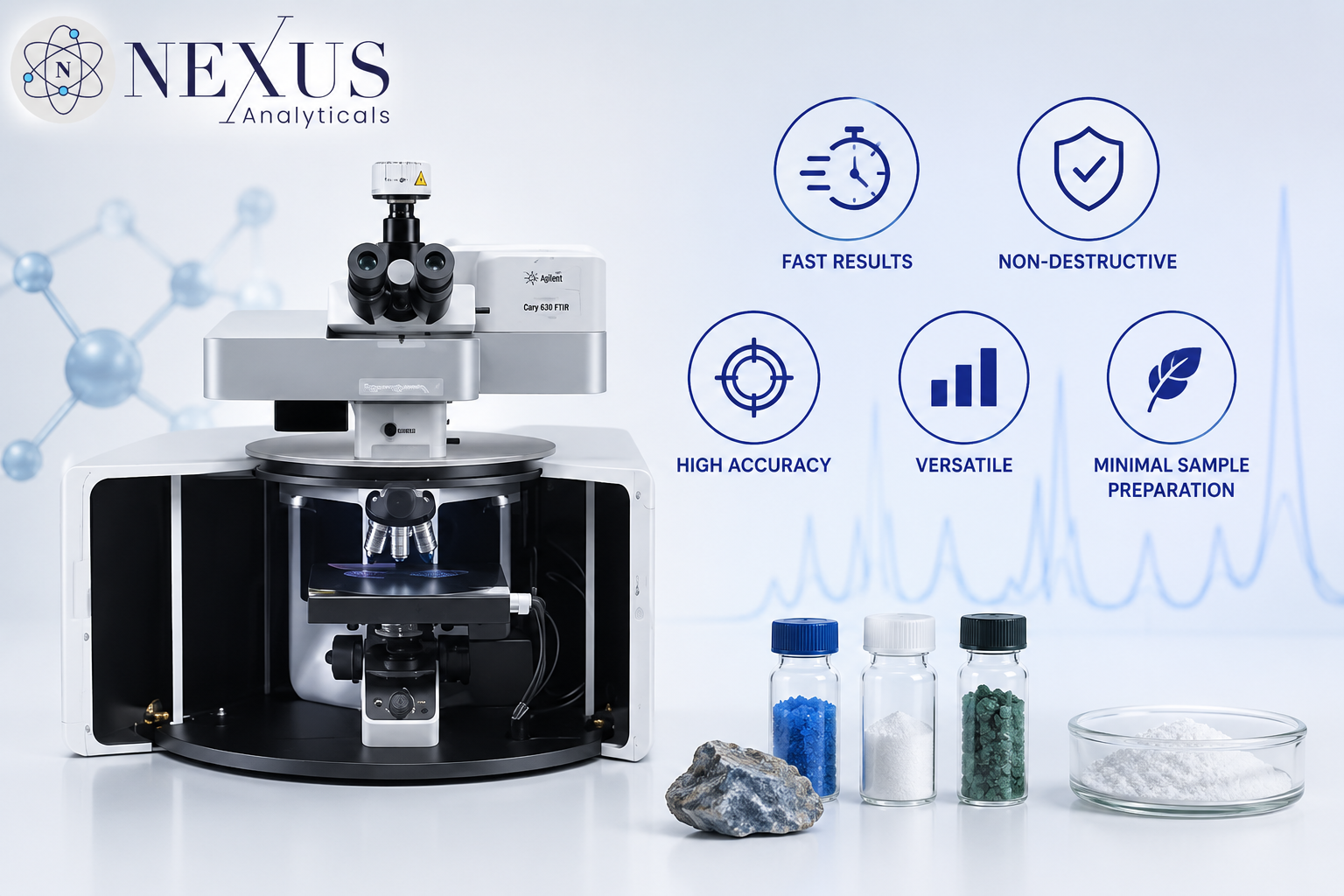
The advantages of Raman spectroscopy are something labs often discover only after switching from older methods. This technique lets you analyze materials without destroying a single sample, and once you see that in action, it is hard to go back.
Did You Know? According to the NIH, Raman spectroscopy is an optical spectroscopy technique that provides a “molecular fingerprint” of a sample.
Whether your work involves pharmaceuticals, food safety, or materials research, accuracy is simply not optional. Delays cost money. Sample damage costs even more. Nexus Analyticals understands this reality. That is why so many labs today rely on Raman spectroscopy for material identification when errors are not something they can afford.
Keep reading to understand exactly why more labs are making this switch every single year.
Key takeaways
- Raman spectroscopy is fully non-destructive; every sample remains completely intact after analysis, allowing retesting whenever needed.
- Real-time molecular analysis returns results in seconds, dramatically reducing lab turnaround and speeding up release decisions.
- Handheld and portable Raman spectrometers bring reliable analytical capability directly to warehouses, field sites, and checkpoints.
- The Bruker BRAVO Raman SOP sets a trusted standard for compliant, reproducible Raman analysis in regulated pharmaceutical environments.
- Regular calibration of the Raman spectrometer is what separates trustworthy, audit-ready data from results you cannot confidently stand behind.
Why So Many Labs Now Prefer Raman Spectroscopy for Faster Results
Speed is part of it. But labs are not switching just for that reason alone. The real pull comes from a combination of things: accuracy you can trust, tools you can carry, and a testing process that never damages what you are trying to study. Traditional analysis methods almost always require some form of sample preparation. That eats up time, uses extra materials, and adds handling steps that increase the chance of error.
With non-destructive chemical analysis through Raman technology, you scan a sample right through its original packaging. Nothing gets opened. Nothing gets damaged. Nothing gets wasted. Here is what makes this method genuinely stand out:
- It uses laser light to interact directly with molecular bonds
- It produces a unique spectral fingerprint for each individual substance
- It works equally well on solids, liquids, and gels
- It needs little to no sample preparation before you begin testing
That combination is hard to find anywhere else. And it is exactly why labs across so many sectors keep choosing this approach.
The Benefits of Raman Spectroscopy That Actually Matter in Practice
Knowing the benefits of Raman spectroscopy helps labs choose instruments that genuinely fit their workflow. Here is a clear breakdown of what you actually get.
Molecular Insight You Can Act on Through Real-Time Analysis
The ability to perform real-time molecular analysis is one of the most practically useful features this technology offers. You are not waiting hours for results. You are getting them in seconds.
Here is how it works. The spectrometer fires a focused laser at your sample. That laser excites the molecular bonds inside the material. Those bonds then scatter light at specific frequencies that are unique to that compound. The instrument reads those frequencies and tells you exactly what you are looking at.
During quality control, that speed is genuinely valuable. One wrong raw material in a batch can trigger a full investigation, a product recall, or worse.
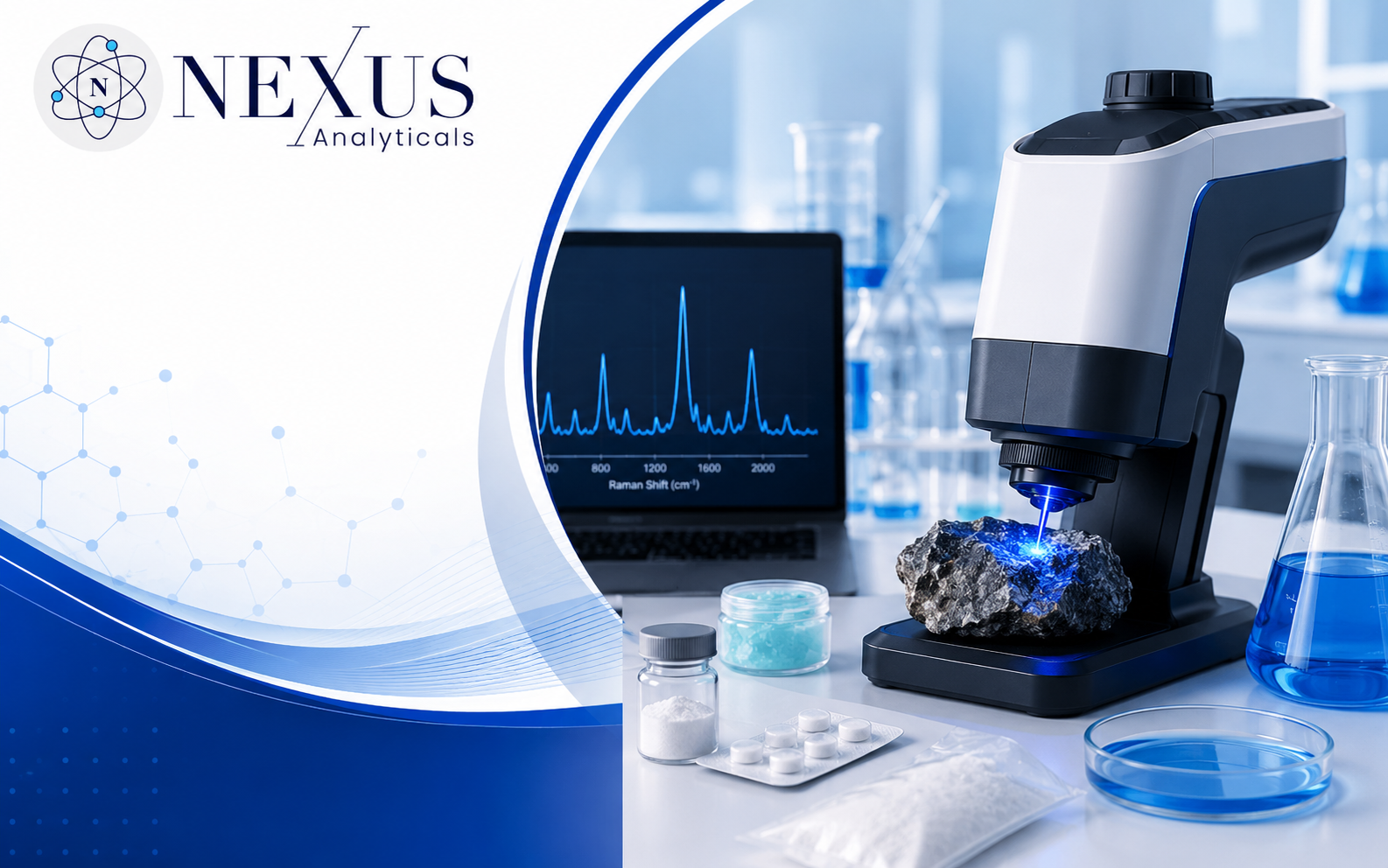
Handles Water-Based Samples Without the Usual Headaches
Water absorbs infrared radiation very strongly. FTIR spectroscopy, that creates real problems when working with aqueous samples. Raman spectroscopy is simply not bothered by water in the same way. The molecular signature of water does not interfere with reading the way it does in infrared methods.
This makes Raman particularly well-suited to biological research, pharmaceutical formulations, and any application where the sample contains a significant amount of water.
Handheld Raman Spectrometer Applications That Go Far Beyond the Lab
Portable instruments have genuinely changed what field analysis looks like. Handheld Raman spectrometer applications now reach into environments that traditional lab tools could never access.
Verifying Raw Materials on the Spot in Pharmaceutical Settings
Within Raman spectroscopy in the pharmaceutical industry, raw material verification is one of the most critical and time-sensitive tasks teams face. Historically, incoming materials had to be sampled, labeled, transported, and queued in a central lab before anyone could confirm identity. That entire process could take days.
Identifying Unknown Substances in the Field for Law Enforcement
Officers working at customs checkpoints or on active investigations use portable Raman spectrometer advantages to identify unknown powders, liquids, and solids without ever opening the container.
Scanning through a sealed plastic evidence bag gives a result that holds up to scrutiny. The investigator stays protected from direct exposure. The sample stays uncontaminated. The chain of custody remains completely intact. That is a significant operational improvement over any method that requires opening a package to sample its contents.
Field Work in Gemology and Geology
Geologists and gemologists carry portable Raman units into locations where traditional lab equipment could never go. A mineral sample identified on-site is a much faster outcome than shipping specimens back to a lab and waiting. Gemstones can be characterized without cutting or surface preparation. That protects specimens that simply cannot be replaced.
How Raman Spectroscopy Compares to Other Methods
| Feature |
Raman Spectroscopy |
FTIR Spectroscopy |
Chromatography |
| Sample Destruction |
None |
None |
Often required |
| Water Interference |
Very Low |
High |
Moderate |
| Analysis Speed |
Seconds |
Minutes |
Minutes to Hours |
| Portable Options |
Yes |
Limited |
No |
| Through-Packaging Testing |
Yes |
No |
No |
| Pharmaceutical Compliance |
FDA-recognized PAT |
FDA-recognized |
FDA-recognized |
Looking at that comparison, it becomes clear why non-destructive chemical analysis through Raman technology tends to win on the criteria that most labs care about day to day.
Getting Calibration Right: The Foundation of Trustworthy Raman Data
Even the best instrument in the world produces unreliable data if calibration is not done properly. Calibration of the Raman spectrometer is not a box-ticking exercise. It directly determines whether you can trust your results.
What Goes Wrong When Calibration Gets Skipped
Over time, even a high-quality instrument can develop subtle drift in its spectral peak positions. That drift is invisible to the naked eye. But it shows up in the data. A compound that should return a clear positive identification comes back with a shifted peak. The system flags it incorrectly. In a pharmaceutical or food safety context, that type of error carries consequences that go well beyond the lab.
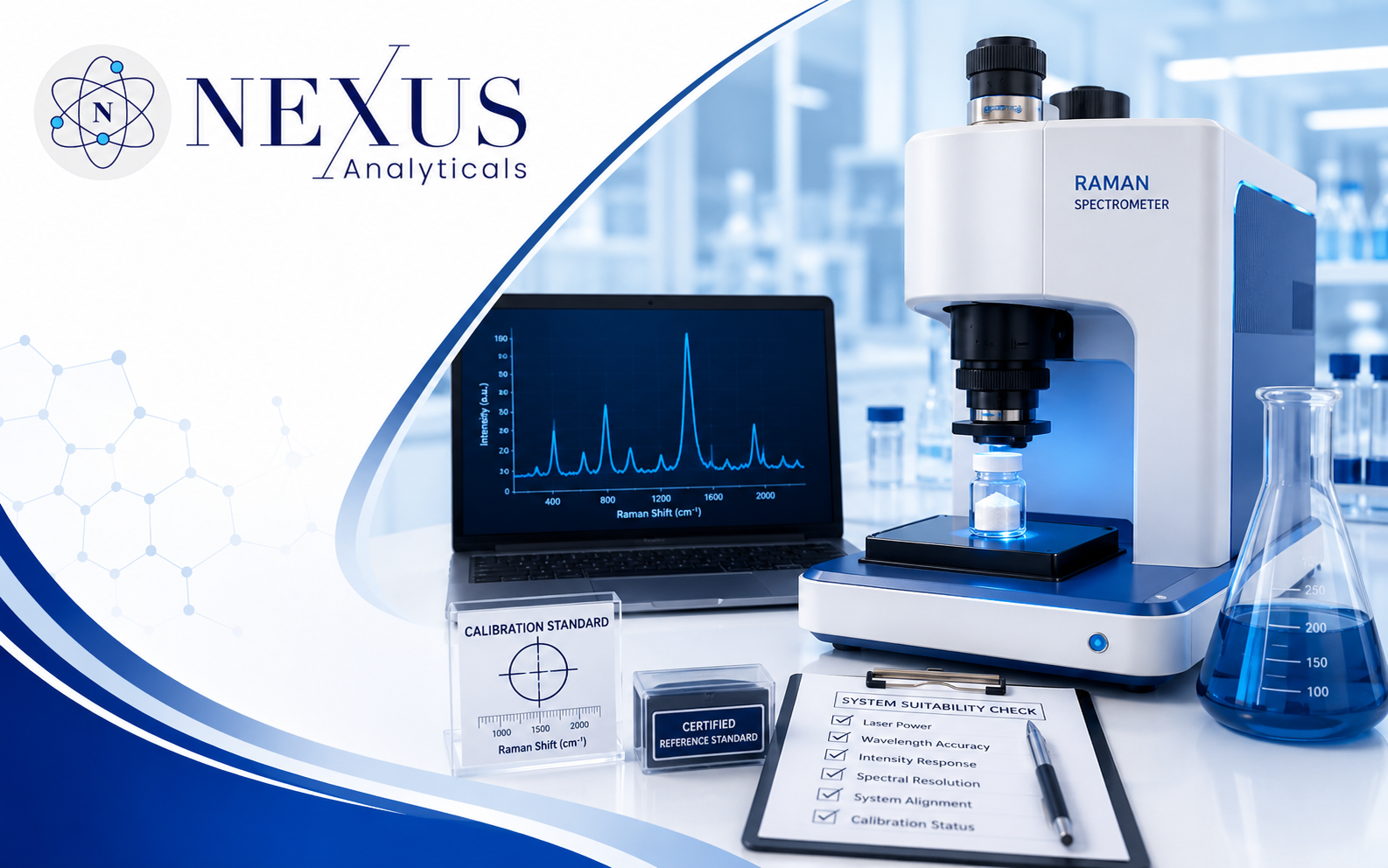
A proper calibration of Raman spectrometer process covers several important steps:
- Wavelength calibration using a certified reference standard
- Intensity calibration to correct for how the detector responds across the spectrum
- Verification testing against compounds with well-established spectral signatures
Many modern instruments handle this through built-in guided routines. This is especially true of devices that operate according to the Bruker BRAVO Raman SOP, where the calibration workflow is designed to be accessible to operators who are not spectroscopy specialists.
The Bruker BRAVO Raman SOP and Why Regulated Labs Trust It
The Bruker BRAVO Raman SOP is not just a product. It represents a complete approach to compliant Raman analysis in regulated environments. BRAVO uses a technology called Sequentially Shifted Excitation (SSE). It operates with two lasers that work together to cancel out fluorescence interference. The SOP workflow built around BRAVO typically includes:
- Automated system suitability checks that run before each analytical session
- Step-by-step calibration prompts that walk the operator through the process
- Timestamped result logging that creates a complete audit trail automatically
- Compatibility with LIMS platforms for documentation that satisfies regulatory reviewers
Labs that consistently follow the Bruker BRAVO Raman SOP tend to report cleaner data, fewer investigation events, and faster batch release cycles.
What Regulators Actually Expect From Raman Spectroscopy in Pharma
The role of Raman spectroscopy in the pharmaceutical industry is not informal or optional in most regulated environments. It is actively encouraged by the agencies that oversee pharmaceutical manufacturing.
The FDA’s PAT guidance specifically promotes real-time analytical methods as a way to improve manufacturing efficiency and reduce reliance on end-product testing. Raman fits that framework directly. The European Pharmacopoeia lists Raman spectroscopy under method EP 2.2.48 as an approved approach for substance identification. Pharmaceutical labs use Raman across a wide range of tasks:
- Confirming the identity of raw materials at the incoming inspection stage
- Monitoring how uniformly active ingredients distribute during blending
- Detecting counterfeit or adulterated products in the supply chain
- Measuring tablet coating thickness without cutting or dissolving the tablet
- Identifying which polymorphic form of an active ingredient is present in a batch
Very few analytical tools cover that range of applications while keeping sample handling requirements so low.
Upgrade Your Lab’s Analytical Power Starting Today!
If your lab still depends on testing methods that destroy samples, require lengthy preparation, or take hours to return results, it is worth taking a serious look at what you could be doing differently. The advantages of Raman spectroscopy are well established across industries and regulatory frameworks. Faster turnaround. Stronger compliance posture. Zero sample loss.
Whether your team needs a portable handheld unit for incoming material checks or a more sophisticated system for regulated pharmaceutical manufacturing, the right option exists. Visit Nexus Analyticals to explore their full range of Raman instruments and related lab solutions. Their team offers expert guidance on selection, installation, calibration support, and ongoing service across India.
FAQs
Q1. What are the main advantages of Raman spectroscopy over FTIR?
Ans: Raman spectroscopy performs reliably with water-based samples, requires no sample preparation, and can analyze materials through sealed packaging. FTIR struggles with water interference and often needs some level of sample prep. Both methods have their place, but Raman offers considerably more flexibility for field, warehouse, and through-container testing scenarios.
Q2. Is Raman spectroscopy suitable for pharmaceutical raw material identification?
Ans: Yes, and it is formally recognized as such. Both the FDA and the European Pharmacopoeia include Raman spectroscopy as an approved method for raw material identification. It allows fast, compliant verification of incoming ingredients without opening sealed containers or preparing samples.
Q3. How often should a Raman spectrometer be calibrated?
Ans: That depends on how the instrument is used and what regulatory framework applies. Pharmaceutical labs typically run system suitability checks at the start of every analytical session. General-purpose labs often calibrate before each use or according to the specific schedule outlined in the manufacturer’s SOP.
Q4. Can a handheld Raman spectrometer replace a benchtop lab instrument?
Ans: For identification and verification tasks, a handheld unit performs very well. For highly complex structural analysis or research requiring maximum spectral resolution, a benchtop system is still preferable. Many labs find the most practical setup is to use both: handheld devices for screening and benchtop instruments when deeper confirmation is needed.
Q5. What is fluorescence interference in Raman spectroscopy, and how is it handled?
Ans: Fluorescence occurs when certain samples emit their own light in response to the laser, which can overwhelm and obscure the actual Raman signal. Instruments using Sequentially Shifted Excitation (SSE) technology, as outlined in the Bruker BRAVO Raman SOP, apply two lasers in a way that mathematically cancels out the fluorescence contribution, leaving a clean and accurate Raman spectrum behind. |
|
|
|