

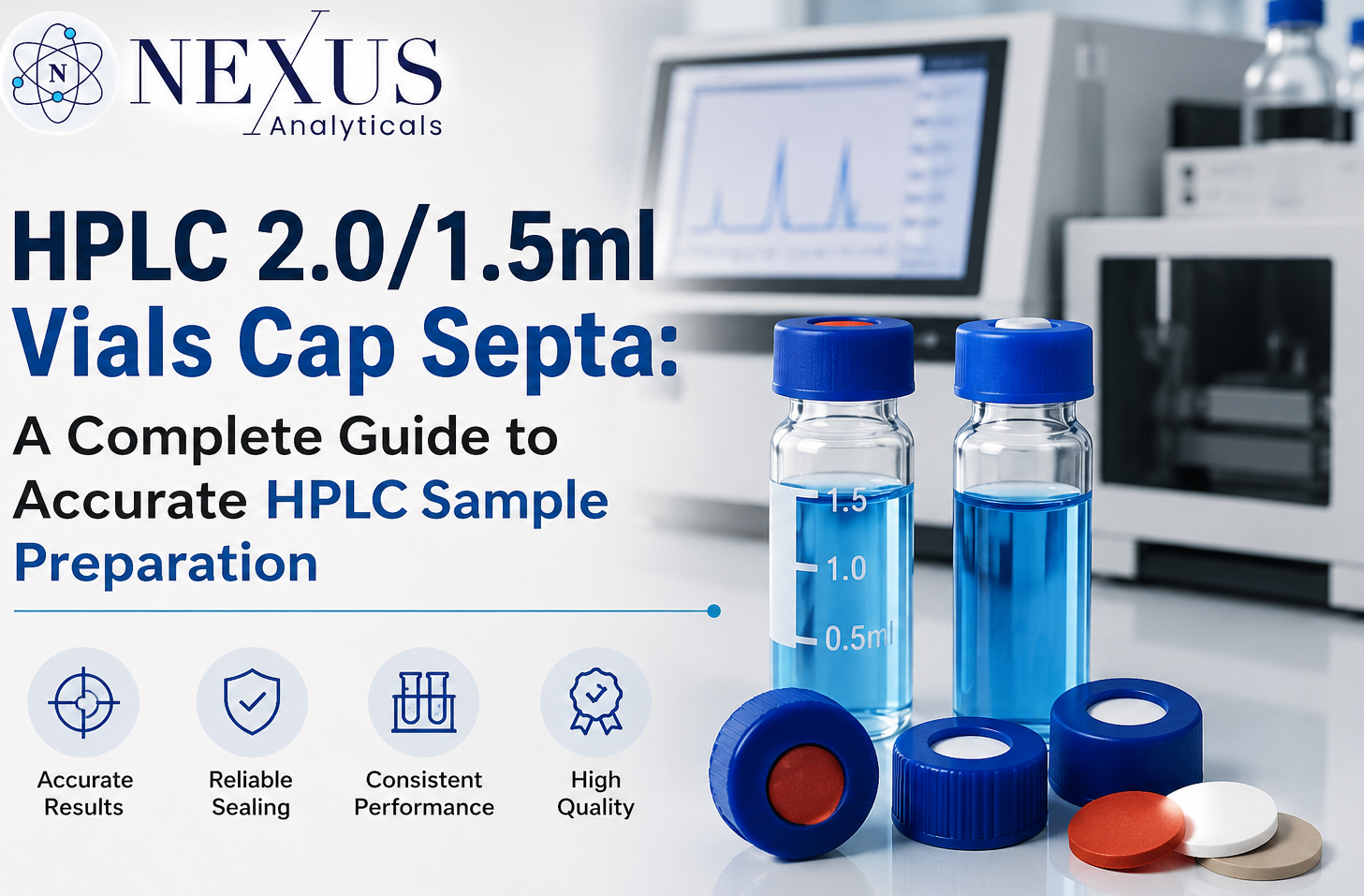
HPLC 2.0/1.5ml Vials and Septa are the small glass containers and rubber seals that hold your sample steady, stopping leaks, evaporation, and contamination before every injection. Pick the wrong pair, and your whole run can fail. Here’s how to get it right, every single time.
According to the National Institute of Standards and Technology, sample carryover and septa coring are among the top causes of inconsistent chromatography results.
That’s why HPLC 2.0/1.5ml Vials and Septa deserve more attention than most labs give them. Nexus Analyticals built its NexPro line to fix exactly this problem, and this guide breaks down what actually matters.
Key Takeaways
- HPLC 2.0/1.5ml Vials and Septa directly affect data accuracy and run consistency.
- Match vial size to sample volume; 1.5ml suits limited or costly samples best.
- Septa material must fit your solvent chemistry to prevent coring and leaks.
- Borosilicate glass and correct cap torque prevent contamination and leaks.
- Reusable vials work only with strict cleaning protocols; single-use removes that risk.
Choosing the Right HPLC Vials and Septa for Every Run
Not all vials behave the same way under pressure, heat, or solvent exposure. The material, cap design, and septa layer all affect your final results. Getting this combination right is not optional if you want reproducible data.
Most labs default to whatever vial their supplier stocks. That’s a mistake. Your choice should depend on sample volume, solvent type, and your autosampler’s needle depth.
2ml vs 1.5ml Vial Selection Guide
Volume isn’t the only factor here. Needle reach, dead volume, and rack compatibility all play a role.
| Feature | 2ml Vial | 1.5ml Vial |
|---|---|---|
| Best For | Standard sample runs | Limited or precious samples |
| Dead Volume | Slightly higher | Lower, ideal for small-volume analysis |
| Rack Compatibility | Universal autosamplers | Space-constrained trays |
| Common Applications | Routine QC testing | Research & micro-sampling |
Pro tip: If your lab handles rare or expensive samples, the 1.5ml option cuts waste without sacrificing accuracy.
HPLC Autosampler Vial Compatibility Matters More Than You Think
Autosampler needles are unforgiving. A vial that’s a millimeter off in height or cap thread can jam the system or misfire the injection. Before ordering in bulk, check:
- Needle penetration depth against your septa thickness
- Vial height against your autosampler tray specs
- Cap thread type, screw or snap, matched to your instrument
- Rack slot dimensions for crimp or snap caps
HPLC autosampler vial compatibility issues rarely show up until mid-run, so testing one batch first saves headaches later.
Septa Material Selection for HPLC Explained
Septa material decides how well your seal holds under repeated needle punctures. Here’s a quick breakdown.
PTFE/Silicone Septa for Clean Injections
This combination resists coring and handles most organic solvents well. It’s the industry standard for routine HPLC work.
Red Rubber/PTFE Septa for Aqueous Samples
Cheaper and reliable for water-based samples, though it wears faster under repeated punctures.
Pre-Slit Septa for High-Throughput Labs
These reduce needle drag and lower the risk of coring, which is when small rubber fragments break off into your sample.
Septa material selection for HPLC should always match your solvent chemistry. Using the wrong septa with aggressive solvents can degrade the seal within days.
HPLC Vial Cap Leak Prevention Tips That Actually Work
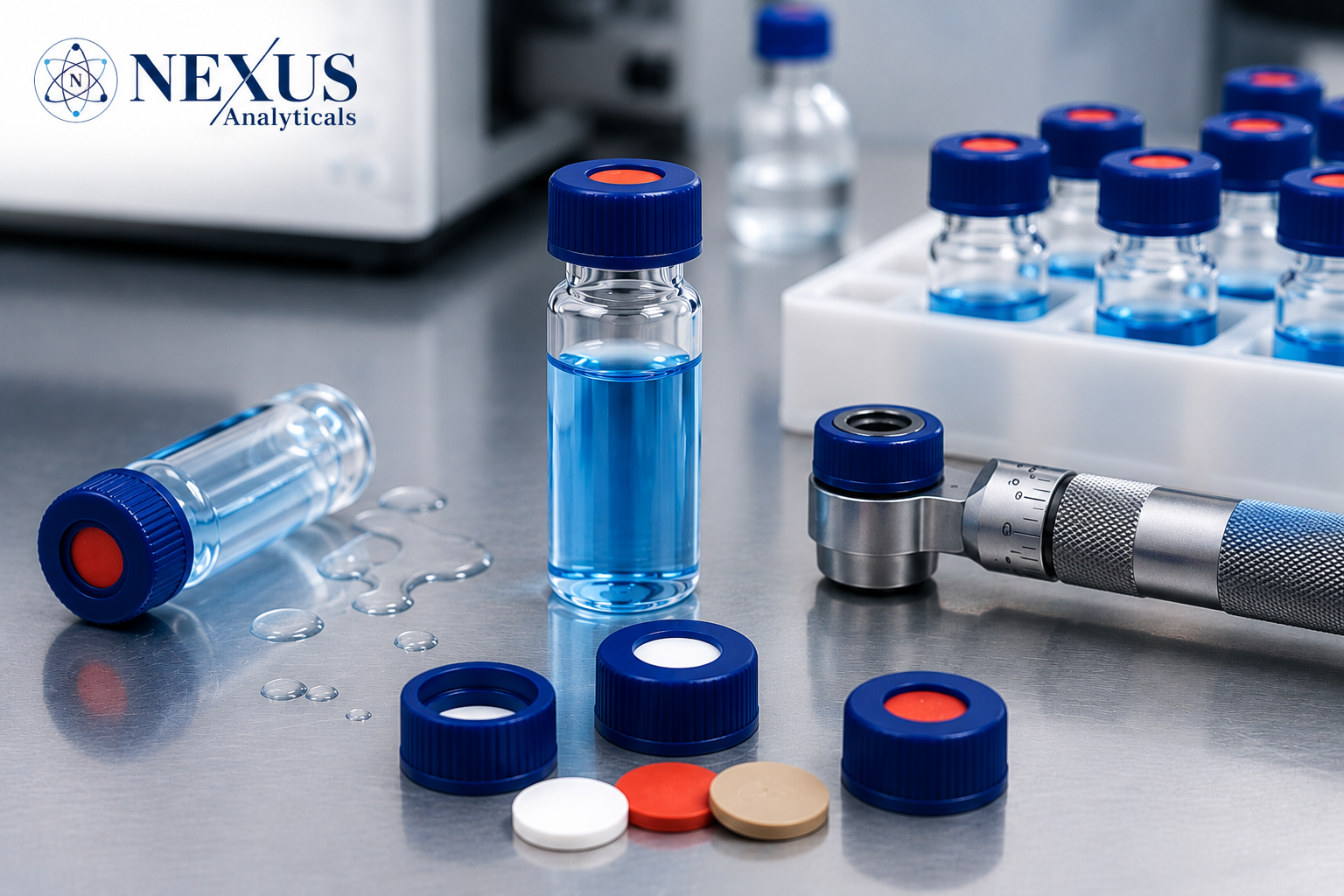 Leaks ruin more runs than most analysts admit. A loose cap lets solvent evaporate, changing your sample concentration mid-batch. Follow these steps to avoid it:
- Tighten caps to the manufacturer’s recommended torque, not by feel
- Store vials upright to prevent solvent pooling near the cap
- Inspect septa for punctures before reuse
- Avoid over-tightening, which can crack borosilicate glass necks
HPLC vial cap leak prevention starts with consistent handling, not expensive equipment.
Why Borosilicate Glass HPLC Vials Are the Industry Standard
Glass quality affects more than durability. Cheap glass can leach ions into your sample, skewing trace-level results.
Borosilicate glass HPLC vials resist chemical interaction with most solvents and acids. They also handle temperature swings without cracking, which matters during sample prep steps that involve heating or cooling.
Labs running trace analysis or method validation should never compromise on glass grade. The cost difference is small compared to the risk of failed audits.
Reusable HPLC Vials vs Single-Use: Which Saves More?
Reusable HPLC vials appeal to labs watching their budget, but reuse comes with tradeoffs. Repeated washing can leave residue or micro-scratches that trap contaminants.
If you do reuse vials, follow a strict cleaning protocol with solvent rinses and visual inspection under light. For trace-level or regulated testing, single-use vials remove that risk entirely.
Best HPLC Vials 2.0ml/1.5ml: What Sets Top Brands Apart
When comparing best HPLC vials 2.0ml/1.5ml options, look past price alone. Check for consistent wall thickness, tight cap tolerances, and certified batch testing.
Glascco 2.0ml/1.5ml Vials for HPLC are known in many labs for tight manufacturing tolerances and consistent optical clarity, which matters for automated fill-level checks.
HPLC Sample Preparation Consumables Checklist
Before your next batch run, confirm you have:
- Correct vial size for your sample volume
- Compatible septa material for your solvent
- Matching caps for your autosampler brand
- Fresh, unpunctured septa on hand
- Proper storage to avoid contamination
Solid HPLC sample preparation consumables planning prevents last-minute scrambling before a deadline run.
Common Mistakes Labs Make With Vials and Septa
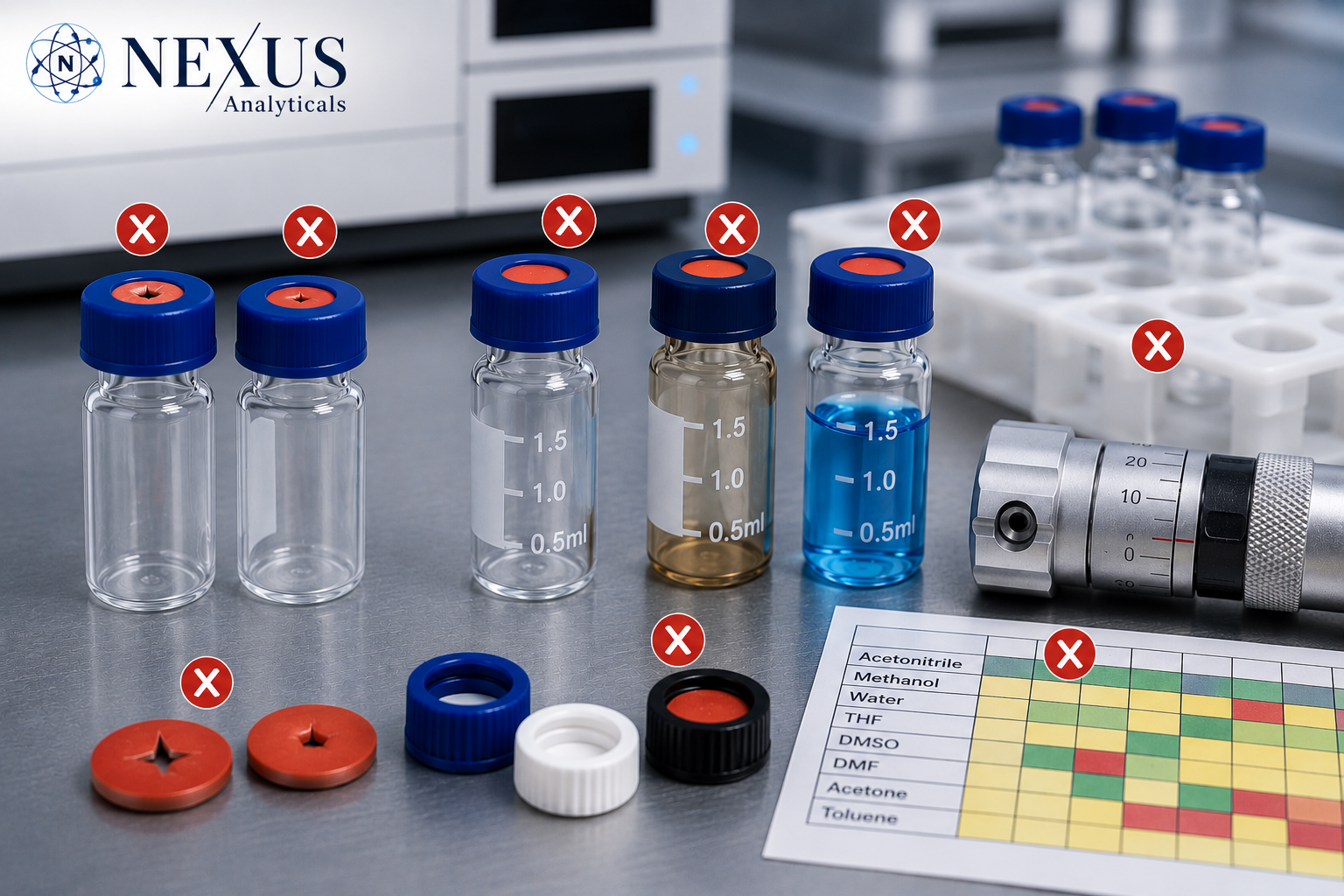 Even experienced analysts slip up here. Watch for these:
- Reusing punctured septa to save cost
- Mixing vial brands mid-batch without checking tolerances
- Ignoring solvent compatibility charts
- Skipping torque checks on capping equipment
Small errors like these compound over hundreds of injections, quietly eroding data quality.
Equip Your Lab with HPLC Consumables You Can Trust!
Consistent chromatography starts with the small stuff: your vials and septa. NexPro consumables from Nexus Analyticals are built to remove guesswork from every batch. Don’t let a five-cent septum wreck a five-hour run. Explore reliable, lab-tested HPLC 2.0/1.5ml Vials and Septa built for accuracy you can trust.
FAQs
- What is the difference between 2ml and 1.5ml HPLC vials?
Ans:- 2ml vials suit routine, larger-volume runs. 1.5ml vials work better for limited or costly samples, reducing waste.
- Which septa material is best for HPLC?
Ans:- PTFE/silicone septa suit most organic solvents. Red rubber septa work well for aqueous, budget-friendly runs.
- Can HPLC vials be reused safely?
Ans:- Yes, but only with strict cleaning and inspection. Regulated or trace-level testing usually calls for single-use vials.
- Why do HPLC vial caps leak?
Ans:- Loose torque, worn septa, and improper storage are the top causes. Regular inspection prevents most leaks.
- Are borosilicate glass vials necessary for HPLC?
Ans:- Yes, for accurate trace analysis. Borosilicate glass resists chemical leaching that can skew sensitive results.