


Choose the wrong ferrule and your entire HPLC run is compromised before it even begins. Read on to find out how to get it right.
According to IDEX Health & Science, HPLC systems (when coupled with the proper equipment) can handle hundreds of samples per day, allowing for rapid drug discovery as well as high-throughput genomics and proteomics work.
Whether you are setting up a new system or troubleshooting a stubborn leak, understanding HPLC ferrules is where the fix usually starts. As a trusted analytical instruments supplier in India, NexPro works closely with laboratory professionals to provide high-quality chromatography consumables and expert guidance for achieving reliable HPLC performance from the very beginning.
Key takeaways
- Material determines the pressure range. PEEK works for standard HPLC up to 400 bar, stainless steel handles UHPLC above 6,000 psi, and PTFE belongs in low-pressure solvent lines only.
- Size matching is non-negotiable. The ferrule must fit the tubing OD and the port geometry precisely, or leaks are guaranteed.
- Finger-tight fittings have limits. They are convenient and reusable, but should never be used in systems exceeding 400 bar.
- Never move a swaged stainless steel ferrule to a new port. It will leak and can permanently damage the receiving port surface.
- Replace ferrules at the first warning sign. Pressure drops, peak distortion, and visible drips all point to ferrule replacement, not repeated retightening.
Why Picking the Right Ferrule Changes Everything in HPLC
The HPLC ferrule is the primary sealing component of the fitting assembly. It sits between the nut and the receiving port, compressing around the tubing to form a tight, leak-proof bond. Without a properly fitted ferrule, mobile phase escapes, pressure drops, and your data becomes unreliable fast.
Think of it this way. The nut provides the force. The ferrule does the actual gripping. Together, they create the seal inside the port that holds everything together under pressure. Get this wrong, and you are looking at:
- Dead volume that broadens your peaks and reduces resolution
- Solvent leaks that can damage surrounding equipment over time
- Sample and mobile phase contamination
- Hours lost chasing a problem that starts with a two-dollar component
Types of HPLC Ferrules and What Each One Actually Does
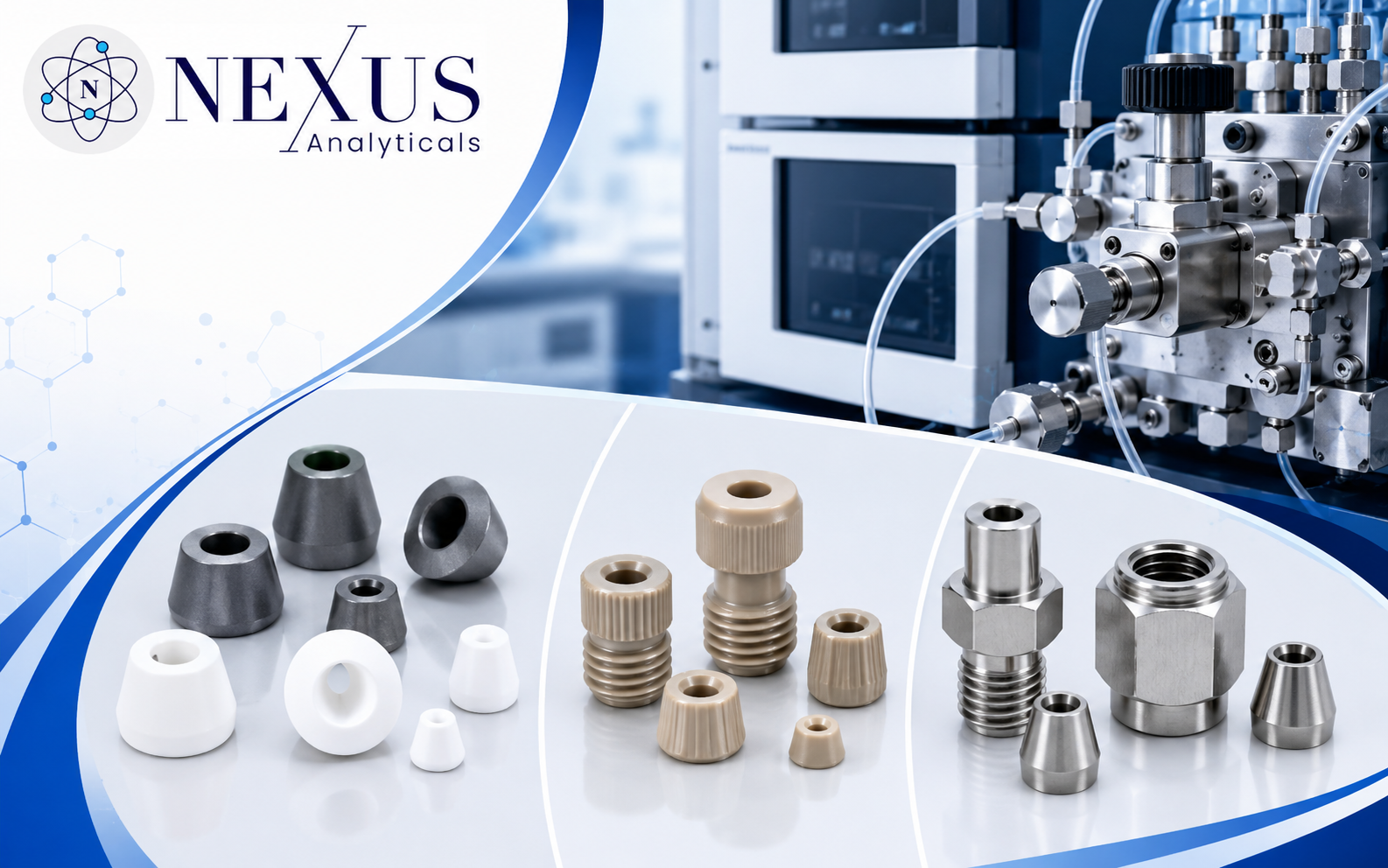
Graphite vs PTFE Ferrules: Choosing the Right Material
This is one of the first decisions most analysts face, and the answer is simpler than it seems. When comparing graphite vs PTFE ferrules, the difference comes down to where and how you use them.
Graphite ferrules are soft and thermally stable. They form a strong seal without cracking under heat, which makes them a solid choice for high-temperature environments and aggressive solvents. The downside is that graphite can shed particles under very high pressure. That is a contamination risk worth noting.
PTFE ferrules are chemically inert to almost every solvent, acid, or base you would encounter in a standard lab. They are widely used for non-pressure solvent and waste lines in HPLC systems. At high pressures, though, they tend to deform and fail.
The simple rule: graphite for GC or high-temperature applications, PTFE for low-pressure or chemically aggressive setups.
PEEK Ferrules for HPLC: Why Most Labs Prefer Them
PEEK ferrules for HPLC have become the go-to choice for a reason. Explore our complete range of chromatography consumables, HPLC columns and GC columns designed to support reliable analytical performance across pharmaceutical and research laboratories. They balance chemical resistance, ease of use, and reusability in a way that neither graphite nor stainless steel can match for routine work.
PEEK fittings are finger-tight up to 400 bar and work well in the low-pressure sections of the flow path. That covers most standard HPLC applications comfortably. Here is what makes PEEK ferrules for HPLC worth using:
- Strong chemical resistance across common mobile phases
- Zero metal ion contamination, which matters for biological samples
- Compatible with most major HPLC instrument brands
- No tools required for installation
Unlike stainless steel, PEEK and other polymer-based ferrules do not permanently attach to the tubing. You can remove and reposition them without destroying them, which saves both time and money during routine column changes.
Stainless Steel Ferrules: The Choice for High-Pressure Work
Once you cross into UHPLC territory or push above 6,000 psi, stainless steel is where you need to be. These ferrules are designed for maximum pressure performance and can support pressures greater than 15,000 psi. They deliver an extremely rigid, permanent mechanical swage onto the tubing.
The trade-off is real: once a stainless steel ferrule is swaged, it is permanently attached. You cannot move it to a different port without risking leaks or dead volume. But for permanent connections at extreme pressures, nothing else comes close.
A Practical HPLC Ferrule Sizing Guide
Sizing mistakes cause more leaks than almost anything else in an HPLC system. Here is a clear HPLC ferrule sizing guide to help you match ferrule to tubing without guessing:
| Tubing OD | Common Ferrule Size | Recommended Material | Typical Use |
| 1/16 inch | Standard 1/16″ | PEEK or Stainless Steel | Most standard HPLC systems |
| 1/8 inch | Standard 1/8″ | Stainless Steel or Graphite | Higher flow applications |
| 0.25 mm metric | M4 or M6 metric | PEEK | Microbore HPLC |
| 1/32 inch | Micro ferrule | PEEK | Nano or capillary LC |
The non-negotiable rule here: the ferrule must match both the tubing outer diameter and the geometry of the receiving port. Mixing incompatible sizes leads straight to leaks, every single time.
Getting Leak-Free HPLC Connections Right the First Time
Leak-free HPLC connections come down to three things working together: the right ferrule, correct installation, and compatible fittings. Here is the proper installation sequence:
- Slide the nut onto the tubing first
- Place the ferrule below the nut with the tapered edge facing away from the nut for high-pressure connections
- Insert the tubing fully into the receiving port until it bottoms out
- Finger-tighten the nut until it is secure
That last point matters more than people realize. The tubing must reach the bottom of the port before you tighten anything. If it does not, you will have dead volume at that junction regardless of how tight the nut is.
Navigating the HPLC Fitting Compatibility Guide
Thread Types in the HPLC Fitting Compatibility Guide
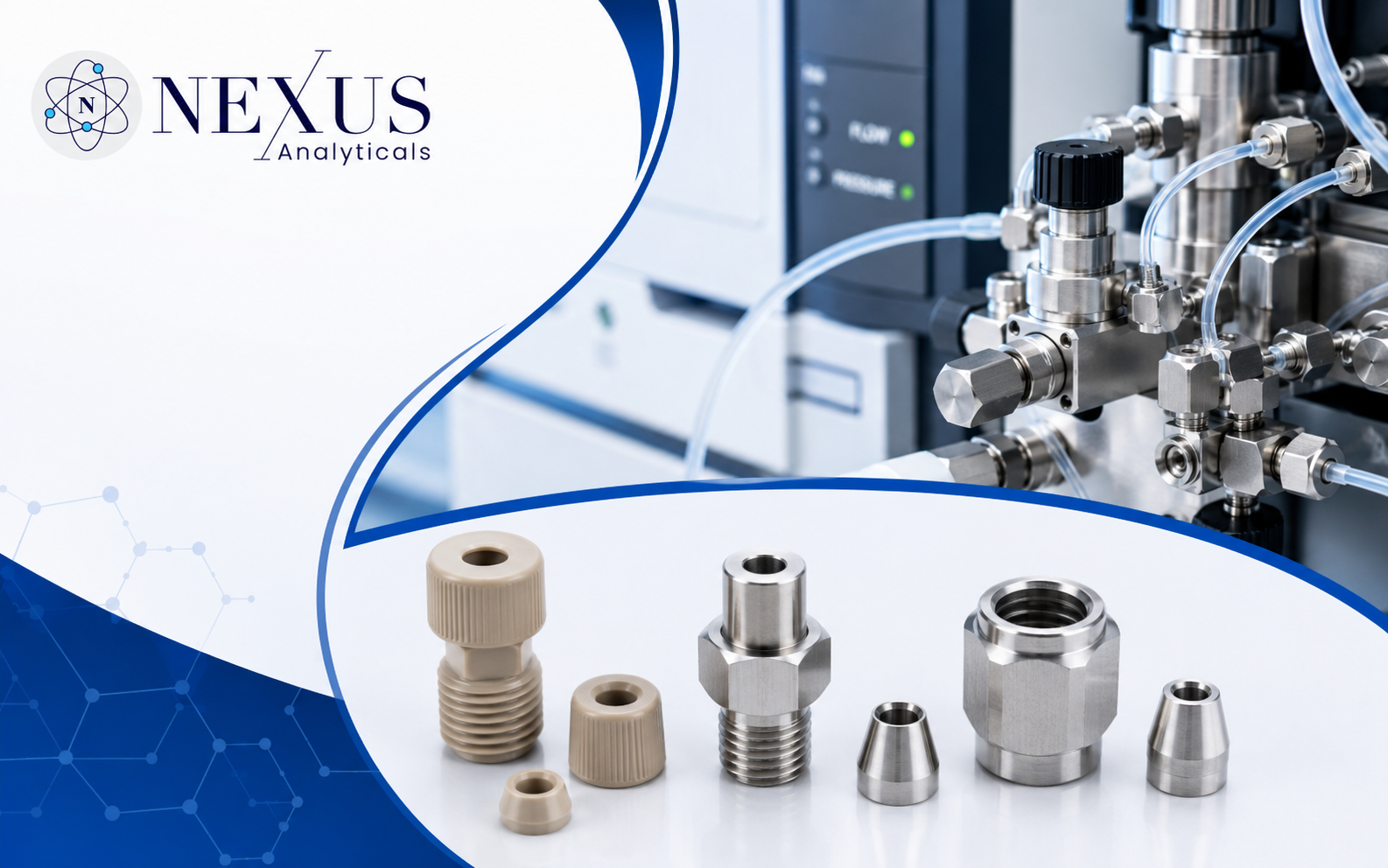
Thread compatibility is the starting point for any fitting selection. The most common thread types in HPLC systems include 10-32 UNF, 1/4″-28 UNF, M6, 5/16″-24 UNF, 6-40 UNF, and 2-56 UNF. Each is specific to certain instruments and port configurations.
Using the wrong thread type on any port will damage the fitting, damage the port, and create a leak that no amount of tightening will fix. Confirm the thread specification on both sides before installation. This step takes thirty seconds and saves hours.
Male Nut PEEK Ferrule for HPLC: How This Combination Works
The male nut PEEK ferrule for HPLC pairing is one of the most practical combinations for everyday laboratory work. The male nut threads into the receiving port while the PEEK ferrule creates the seal around the tubing body. This setup handles pressures up to around 400 bar reliably and is the preferred choice when column changes happen on a regular basis.
Finger Tight Fitting for HPLC: What It Is Good For
A finger-tight fitting for HPLC is exactly what the name suggests. You tighten it by hand, no wrench needed. Most polymer finger-tight fittings are reusable and can be repositioned multiple times as long as the ferrule body remains undamaged and the seal surface is clean.
Where they fall short is at extreme pressures. Keep finger-tight fittings in systems operating below 400 bar. Above that threshold, use tool-tightened stainless steel fittings instead.
Ferrule Replacement for HPLC Fittings: Know When to Change
Ferrule replacement for HPLC fittings is one of those maintenance tasks that gets delayed far too often. Here are the signs that tell you it is time to replace, not retighten:
- Visible solvent dripping or pooling around a connection point
- Pressure readings that fluctuate without an obvious cause
- Peak tailing or broadening that the column condition cannot explain
- A ferrule that looks cracked, compressed unevenly, or visibly deformed
Retightening a failing ferrule rarely works. It usually just delays the inevitable while increasing the risk of port damage. Swap it out and move on.
Column-to-Detector Seal Components: A Section Most People Ignore
The column-to-detector seal components in your HPLC system sit under constant high pressure and carry separated analytes directly to the detector. Any dead volume here shows up as peak broadening that can look like a failing column when the real problem is the fitting.
Use the smallest practical bore tubing and ferrule at this point in the flow path. Match everything to the detector inlet port specification exactly. Even a small mismatch in the internal diameter of a ferrule at this position can distort your chromatogram in ways that are hard to trace back to the source.
Improve System Reliability with the Right HPLC Ferrule!
Leaks, dead volume, and inconsistent peaks often trace back to a single overlooked component. The HPLC ferrule you choose controls more of your system performance than most analysts give it credit for. Get the material right, confirm the size, check thread compatibility, and install it correctly the first time. For precision HPLC consumables and reliable product guidance from a trusted supplier, visit NexPro and find the right components for your system today.
Along with selecting the right fittings and consumables, routine validation and calibration services help laboratories maintain accurate analytical results, improve instrument performance, and meet regulatory requirements.
FAQs
Q1. What is an HPLC ferrule, and what does it do?
Ans: An HPLC ferrule is a small sealing component that sits between the fitting nut and the receiving port. It compresses around the tubing to create a tight, leak-free connection and eliminate dead volume at each junction in the flow path.
Q2. What is the difference between PEEK and stainless steel HPLC ferrules?
Ans: PEEK ferrules are chemically resistant, reusable, and suitable for pressures up to around 400 bar. Stainless steel ferrules handle pressures above 15,000 psi but permanently attach to the tubing once swaged and cannot be reused in a different port.
Q3. How do I know what size ferrule my HPLC system needs?
Ans: The ferrule size must match the outer diameter of your tubing and the geometry of the receiving port. The most common size for standard HPLC tubing is 1/16 inch OD. Always verify against your instrument specification before ordering.
Q4. Can HPLC ferrules be reused?
Ans: PEEK and other polymer ferrules can generally be reused a limited number of times, provided they are not cracked or deformed and the seal surface remains intact. Stainless steel ferrules that have been swaged are not reusable in a different port and should be replaced.
Q5. Why is my HPLC fitting still leaking after installing a new ferrule?
Ans: Common causes include tubing not fully seated at the port bottom, mismatched thread types, a damaged or scratched receiving port, or a ferrule that is incompatible with the fitting system. Always inspect the receiving port for burrs or damage before installing a replacement ferrule.