
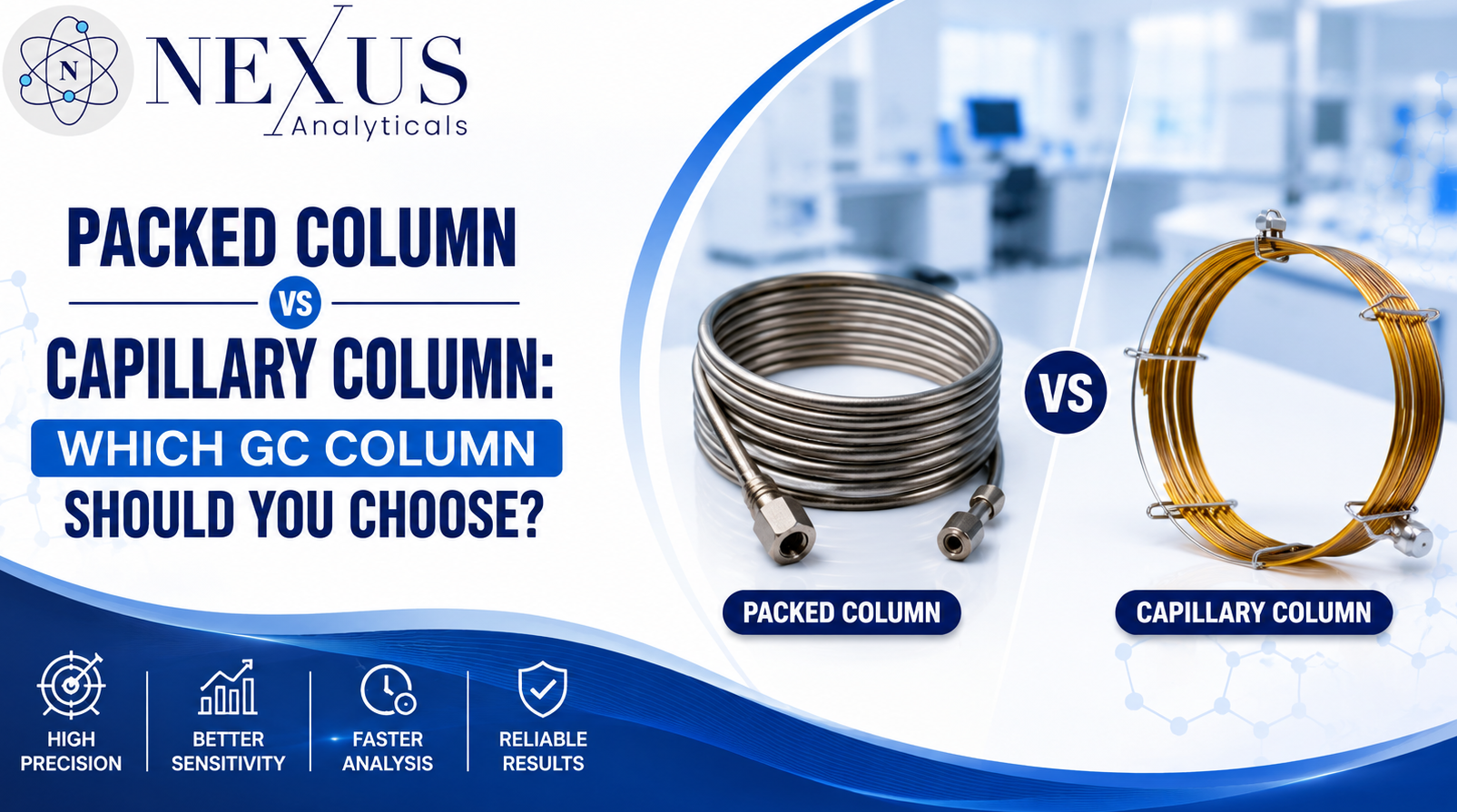
Which GC Column should you choose between a packed column and capillary column depends on your sample type, resolution needs, and lab setup. And most analysts only figure that out after wasting a frustrating amount of time on the wrong column.
Did you know? The American Chemical Society reports that gas chromatography is among the most practiced analytical techniques on the planet, with countless analyses running daily across pharmaceutical, environmental, food safety, and petrochemical sectors.
If you have ever stared at a noisy chromatogram, wondering where your peaks went, there is a decent chance the column choice played a role. It is one of those decisions that looks simple on the surface but quietly shapes everything downstream: your resolution, your sensitivity, your run time, even your detector compatibility.
Key takeaways
- Packed columns handle high sample volumes and remain the best fit for permanent gas analysis, preparative separations, and legacy GC instruments.
- Capillary columns consistently outperform on resolution and sensitivity, making them the practical default for modern analytical and trace-level work.
- The fundamental difference between packed and capillary columns lies in their diameter, length, sample capacity, and how the stationary phase is applied.
- Choosing the right capillary column means working through four variables in order: length, inner diameter, film thickness, and stationary phase polarity.
- Your detector type, sample matrix, available volume, and budget should all factor into your gas chromatography column decision before you place any order.
How Packed Columns and Capillary Columns Actually Function
Before jumping into comparisons between packed column vs capillary column, let us get the basics sorted.
What Makes a Packed Column Tick in GC Work?
Picture a short, wide tube stuffed with solid particles. Those particles carry a liquid stationary phase on their surface. That is your packed column in a nutshell. These columns typically run 1 to 4 meters long with an inner diameter of 2 to 4 mm.
They are not delicate. They accept larger sample volumes, tolerate higher flow rates, and hold up well under demanding industrial conditions. For certain applications, that toughness is exactly what you need.
Why Capillary Columns Became the Lab Standard
A capillary column in gas chromatography looks nothing like its packed counterpart. It is long, narrow, and open inside. Lengths stretch from 15 to 100 meters. Inner diameters sit between 0.1 and 0.53 mm.
The stationary phase bonds directly to the inner wall rather than coating a packed material. That single design choice is responsible for the dramatically sharper separations and higher peak resolution that made capillary columns the dominant choice in modern analytical labs. A Restek GC Column is a common example of this bonded-phase design, prized by analysts for its consistency batch after batch.
Thus, both packed column and capillary column are designed for specific analytical needs, and selecting the right one depends on your sample type, separation goals, and instrument requirements. An RTx Column, for example, is built around this bonded-phase, open-tubular design, which is exactly why it performs so well against a traditional packed setup.
Difference Between Packed and Capillary Columns
Here is a side-by-side breakdown of the difference between packed and capillary columns that you can actually use when writing a method or justifying a purchase:
Packed Column Applications in GC: They Are Not Going AnywhereThe rise of capillary technology did not kill packed columns. Not even close. Solid packed column applications in GC still exist across multiple industries, and ignoring them means potentially choosing a more expensive, less suitable option for your work. Here is where packed columns genuinely outperform:
These columns are workhorses. They are not glamorous, but they get the job done reliably in the applications they were designed for. GC Capillary Column Selection Guide: Four Variables That Actually MatterDeciding to use a capillary column is just step one. Choosing the right capillary column is where analysts often get stuck. This practical GC capillary column selection guide breaks it down into four decisions. Length: Balancing Resolution Against Run TimeLonger columns separate compounds more cleanly. A 60-meter column handles complex mixtures that a 15-meter column simply cannot resolve. The catch is longer run times. Choose the shortest column length that still meets your resolution requirements. Inner Diameter: Sensitivity vs Sample ToleranceNarrow columns between 0.1 and 0.25 mm push sensitivity to its limits. Wider columns between 0.32 and 0.53 mm handle bigger injection volumes without peak distortion. Match this to your detector and your typical sample concentration. For volatile organic compound work under EPA methods, a wider-bore DB624 Column is a common choice, since it tolerates the larger injection volumes typical of purge-and-trap and headspace sampling. Film Thickness: Holding Power for Volatile CompoundsThick films retain volatile compounds longer, giving them time to separate properly. Thin films let high-boiling compounds elute more easily without tailing. Get this wrong, and your early-eluting peaks blur together. The RTx 624 Column is a frequent pick for this kind of work, since its film chemistry is built specifically to hold onto light, fast-eluting volatiles long enough for them to separate cleanly. Stationary Phase Polarity: The Most Overlooked VariableThis one causes more failed methods than most analysts admit. The polarity of your stationary phase needs to match your analytes. Non-polar phases separate hydrocarbons cleanly. Polar phases handle oxygenated compounds, alcohols, and amines far better. For glycol-heavy or highly polar samples, an EGDG column phase is often the better-suited option, since it is formulated to handle compounds that non-polar phases simply cannot separate well. Fast-Moving Restek GC Column Part Numbers to Keep in StockOnce you have settled on the right column type, the next practical step is knowing exactly which part number to order. Below are some of the fastest-moving Restek capillary column part numbers, so you can match your method requirements to the correct catalog number:
|